Demo & Resources

Explore our demos and resources at RATE@UM.

Demo videos

2
Demo videos

Collaborative Training for Precast Facade Installation using BIM and Multi-user VR

Enabled by BIM and multi-user VR, the system aims to empower collaborative training of precast facade installation among crane operators and riggers. Compared to conventional practice and prevalent VR systems, our system provides a safe, economical, and collaborative approach for construction trainees to better know the operational procedures as well as the mutual influence among co-workers in different trades.

Watch demo
Demo videos

Loco-AR: Lift Operation Coordination using BIM and Multi-user AR

Loco-AR is developed to connect lifting supervisors and crane operators to enhance lifting operation coordination. It consists of two units: a BIM-based information exchange unit that supplies workers with critical project information and provides geometries of building structures and cranes for visualization; and a multi-user AR interaction unit that superimposes the tempo-spatial AR-BIM models to reality and engages workers in a shared environment for concurrent manipulation. The system shares a vision of promoting the adoption of BIM and multi-user AR for remote collaboration in onsite construction.

Watch demo

Resources

1
Resources

HBD: A Semantic 3D Reconstruction-oriented Image Dataset for Building Component Segmentation

The HBD (Hong Kong University Building Image Dataset) dataset contains 3,378 images collected from both interiors and exteriors of 36 buildings with different architectural styles and various space types on the campus of HKU. The dataset was precisely annotated with 11 common building component types on the object instance level, including wall, curtain wall, floor, ceiling, roof, column, beam, lift, window, door, and opening, in a way suitable for 3D building semantic reconstruction. This yielded 49,380 object instances. Compared to existing building datasets, our HBD dataset stands out by offering significant advantages: it encompasses more object types essential to building reconstruction, includes a larger number of object instances, covers both interior and exterior scenes, and features annotations tailored for 3D building reconstruction.

View details

Academic Conference

1
Academic Conference

A Framework of Integrating HBIM and GIS for Automated Fire Risk Assessment of Heritage Buildings

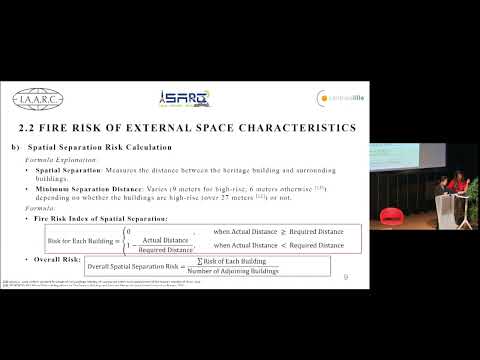
Historic buildings face multi-faceted fire risks that threaten their conservation. A comprehensive fire risk assessment is essential to prevent fires and protect cultural heritage. Conventional practices rely on surveys and site visits, which are inefficient in capturing up-to-date information digitally and analyzing the risk levels quantitatively. This paper proposes a framework integrating Historic Building Information Models (HBIM) and Geographic Information Systems (GIS) to enable automated, data-driven fire risk assessment of historic buildings. The framework consists of two key phases: quantitative fire risk modeling and automated risk assessment. The risk modeling defines unified indicators in accordance with fire safety regulations to quantify the risks exposed to the heritage buildings internally and externally. Both inherent building characteristics (e.g. fire resistance rating) and external spatial characteristics (e.g. adjacent access and spatial separation) were assessed. Next, the automated assessment utilizes HBIM and GIS to extract building and surrounding area information, compute the quantitative risks, and develop an interactive visualization platform to facilitate stakeholders in decision-making. The feasibility of this framework is verified through a case study of Mandarin s House in Macau. The results indicated the framework is capable of quantifying the risk related to fire-resistant materials (0.66), external access (0.75) and separation (0.76). The results demonstrate that the proposed framework could contribute a unified fire risk model quantification method and a BIM and GIS-combined mechanism for automated risk assessment to support the proactive conservation of valuable cultural heritage assets.

Watch demo